
Manhattan, NYC
Sciatica Acupuncture — Natural Sciatic Pain Relief
Don't let sciatica control your life. Our specialized acupuncture treatments target the root cause of sciatic nerve pain, providing lasting relief without drugs or surgery.
What is Sciatica Acupuncture Treatment?
Sciatica acupuncture treats the shooting pain that runs from the low back through the buttock and down the leg, by releasing the piriformis and gluteal muscles that compress the sciatic nerve and calming the irritated nerve root. Intake takes 20 minutes, treatment 40 minutes, and needles stay in for about 25 minutes.
Clinic facts
- Rating
- 5.0 / 5 · 23 Google reviews
- Experience
- 15+ years · 2 licensed L.Ac.
- First visit
- 75 minutes
- Follow-up
- 45–60 minutes
- Address
- 408 West 57th Street, Suite 1K, New York, NY 10019
- Hours
- Mon–Fri 9am–7pm · Sat 9am–5pm
- Phone
- (212) 265-2052 · text (347) 875-2805
- Languages
- English · 中文
Do You Have Sciatica?
Sciatica has a way of taking over a life. The shooting pain down the back of the leg every time you get up from your desk. The numb spot in the foot that won't go away. The 20-minute negotiation with your own body before you can find a position in bed that doesn't make it worse. By the time most people search for sciatica acupuncture in Manhattan, they've already tried rest, ibuprofen, a couple of cortisone considerations, and possibly a round of physical therapy. The pain is still there.
Sciatica is not really one condition — it's a symptom with several possible drivers. A herniated lumbar disc compressing the L5 or S1 nerve root. The piriformis muscle squeezing the sciatic nerve where it exits the pelvis (piriformis syndrome). SI joint dysfunction referring pain down the leg. A combination of all three in the postpartum patient or the person who sits 10 hours a day. Sciatic nerve pain acupuncture works because we can address each of those drivers — releasing the piriformis with targeted motor-point needling, reducing inflammation at the nerve root with electroacupuncture along the bladder and gallbladder meridians, and balancing the lumbar paraspinals with cupping and Tui Na.
Our Midtown Manhattan clinic on West 57th Street — near Columbus Circle, between 9th and 10th Avenue on the Hell's Kitchen / Lincoln Square border — sees a steady stream of sciatica patients. Postpartum parents whose pelvis has not settled. Finance and consulting clients whose lower back acupuncture appointments have been needed for years. Lyft and Uber drivers, restaurant workers, anyone who sits in awkward positions for long stretches. The good news: acute sciatica often responds quickly. The honest news: chronic sciatica of months or years usually needs a real course of work, not a single visit.
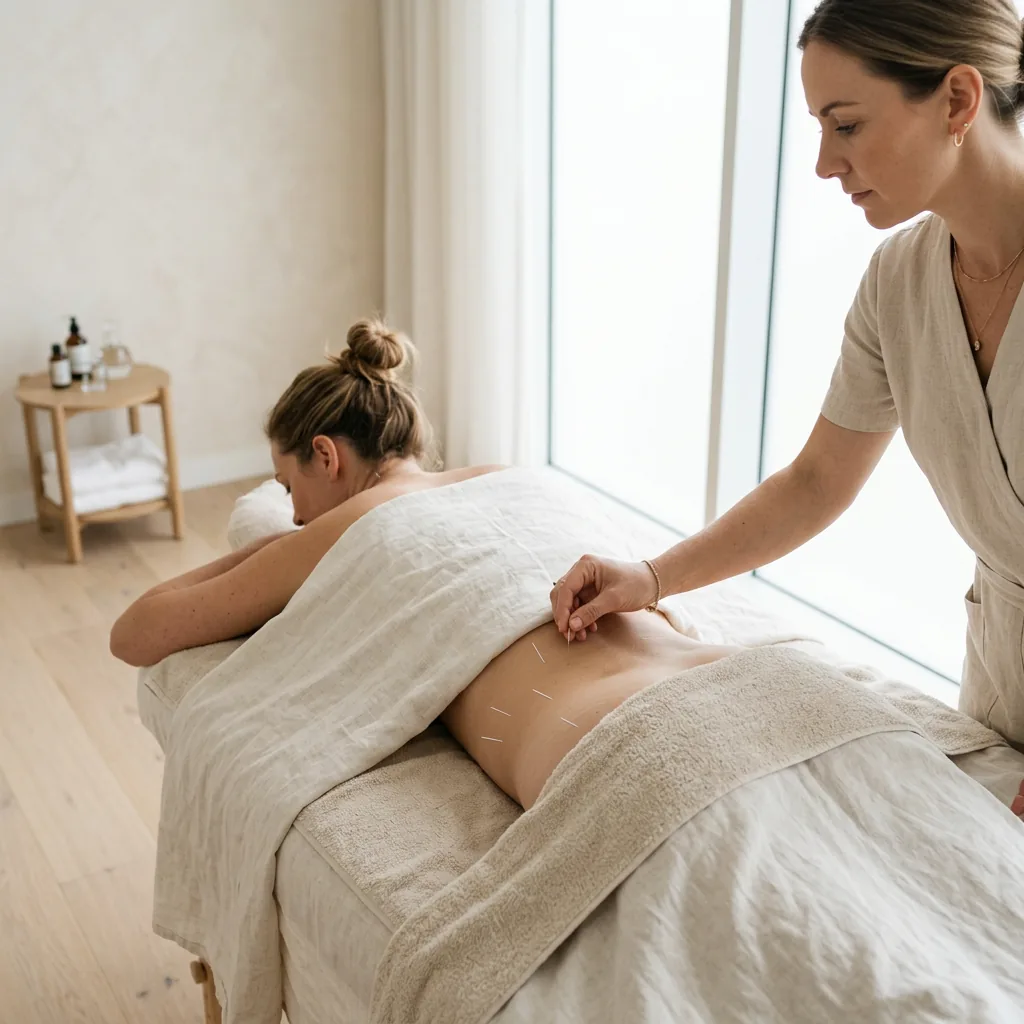
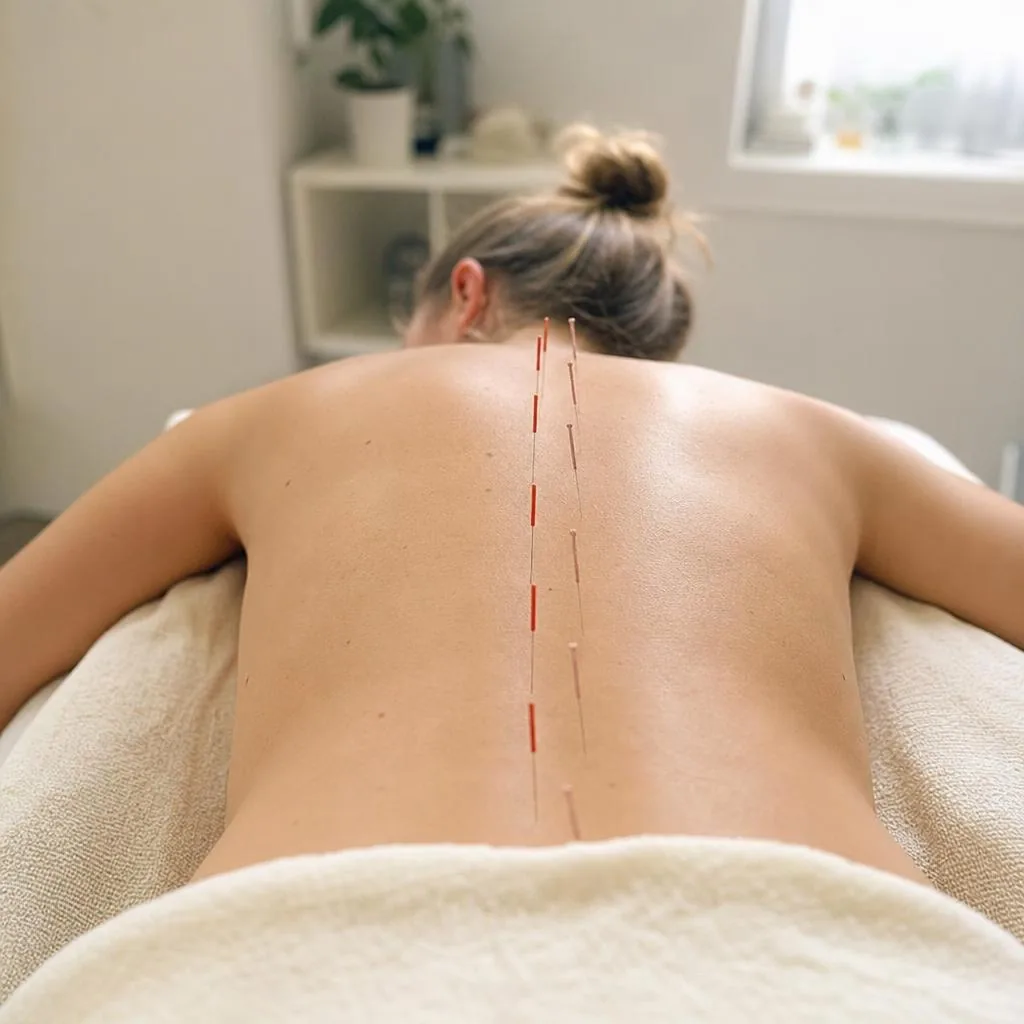
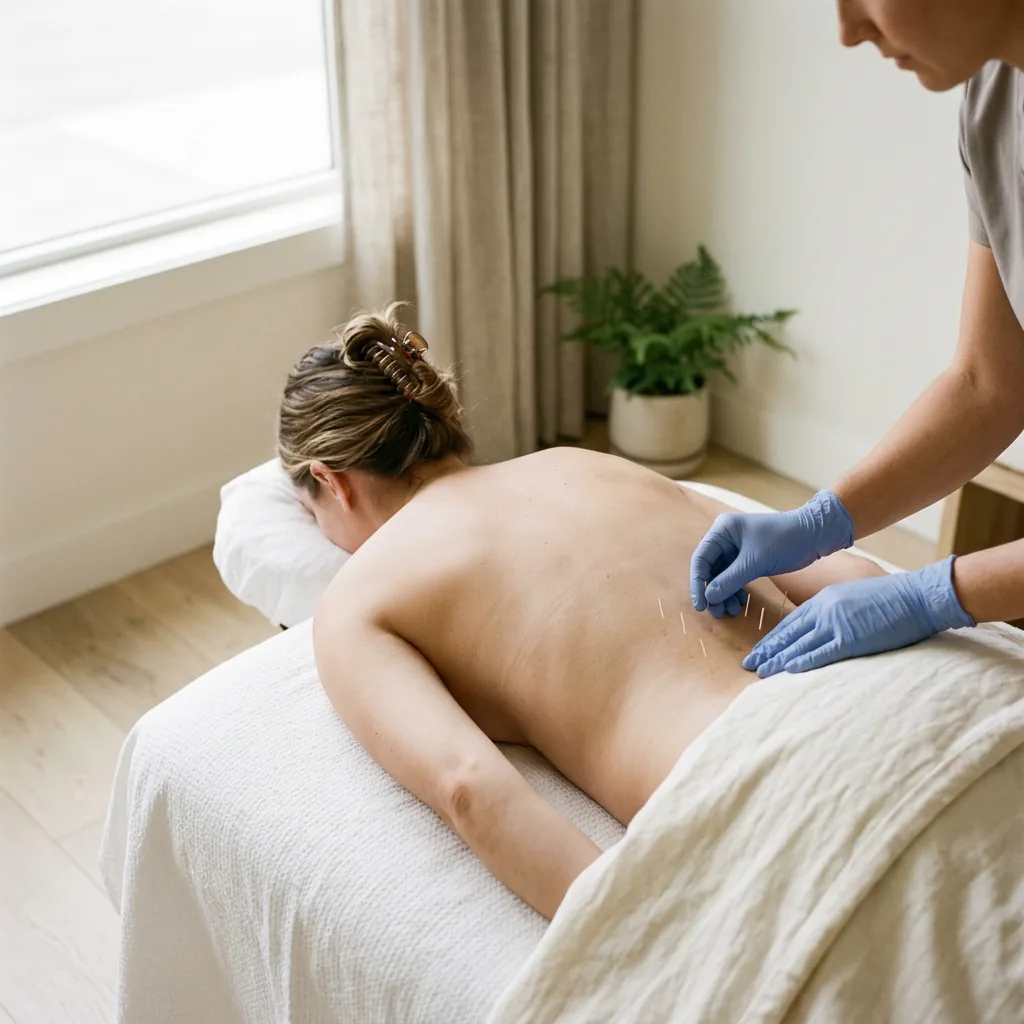
Inside the Treatment Room
Conditions We Treat
Classic disc-related sciatica (L5/S1 radiculopathy)
Sharp shooting pain from the low back down the back or side of the leg, often with numbness or tingling in the foot. Worse with sitting, coughing, or bending forward.
Piriformis syndrome
Sciatic nerve compression at the piriformis muscle deep in the buttock. Pain that's worse with prolonged sitting and often reproduced by crossing one leg over the other.
Sacroiliac (SI) joint dysfunction
One-sided buttock pain that can radiate down the leg, often confused with sciatica. Worse with rolling over in bed or single-leg activities.
Postpartum sciatica
Common after pregnancy as the pelvis resettles and ligaments tighten back up. Often paired with weak gluteals and SI joint instability.
Chronic sciatica from prolonged sitting
The pattern we see most in Manhattan office workers — tight hip flexors, weak glutes, and a sciatic nerve that gets squeezed every workday.
Sciatica with foot drop or numbness
When there's measurable weakness or sensory loss, we want to make sure imaging and a spine consult are part of the picture before we focus on conservative care.
Recurrent sciatica between flare-ups
The person whose sciatica comes and goes — three good months, then a week of misery. Often responds well to a maintenance schedule.
Benefits
- · Releases the piriformis and gluteus medius — the two muscles most often squeezing the sciatic nerve
- · Reduces inflammation around the lumbar nerve roots with targeted electroacupuncture
- · Restores blood flow along the bladder and gallbladder meridians — the channels that run the path of sciatic pain
- · Calms the protective muscle guarding that makes acute sciatica turn chronic
- · Stimulates endorphin release for genuine, drug-free pain relief during and after the session
- · Works alongside gabapentin, muscle relaxants, NSAIDs, or oral steroids — no drug interaction
- · Addresses the TCM pattern (often cold-damp obstruction or qi-blood stasis) so the sciatica is less likely to keep coming back
What to Expect
- 1
Pain mapping & TCM intake (20 min)
We trace exactly where your sciatic pain runs — from the lower back into the buttock, down the back or side of the thigh, into the calf, possibly into the foot. We ask what worsens it (sitting, standing, getting out of the car, coughing), what eases it, how long it has been going on, and whether you've already had imaging or a diagnosis from a spine doctor. We check basic neurological signs — straight-leg raise, calf strength, sensation in the foot. Tongue and pulse follow, and we explain the TCM pattern (often cold-damp obstructing the channel, or qi and blood stasis along the bladder and gallbladder meridians) in plain language.
- 2
Treatment (40 min)
Points are chosen along the affected meridians on the lower back, buttock, and leg, with distal points on the foot and hand to balance the treatment. For most patients we add gentle electroacupuncture across two needles in the buttock or hamstring — this is the technique that tends to give the fastest reduction in sharp shooting pain. Cupping or Tui Na on the piriformis and gluteus medius is often added when those muscles are clearly part of the picture. You rest with the needles in for about 25 minutes.
- 3
Follow-up cadence & self-care
Acute sciatica often responds quickly — we typically book twice in the first week, then weekly for 4–6 weeks. Chronic sciatica of months or years may need a longer course. We send you out with simple guidance: how long to sit at a time, two stretches you can do without aggravating the nerve, and when to use heat versus ice. If you have not had imaging and the pattern suggests a structural cause (significant weakness, numbness in the saddle area, loss of bladder or bowel control), we send you back to your primary care doctor or directly to a spine specialist — that is not the place to wait.
Sciatica Acupuncture at a Glance
| What you want to know | Answer |
|---|---|
| Session structure | 20 minutes of pain mapping and TCM intake, then a 40 minute treatment with roughly 25 minutes of needle retention. |
| Where the needles go | Piriformis and gluteal trigger points, the lumbar segment feeding the nerve root, and distal points down the leg. |
| Evidence base | A 2017 evaluation of 49 studies with more than 7,900 participants found a moderate benefit for chronic low-back pain, the condition sciatica most often accompanies. |
| When to see a doctor first | Loss of bladder or bowel control, or progressive weakness in the leg, needs urgent medical assessment — not acupuncture. |
Why choose Delight for sciatica
Sciatica is a primary area of practice for Dr. Yu Qi, L.Ac. (MSTOM, 7+ years), who has built her work around acute and chronic pain — including sciatica, low back pain, and nerve-related conditions. She is comfortable with the diagnostic distinctions that matter here: piriformis syndrome versus disc-related radiculopathy versus referred SI joint pain often look similar on the surface but respond to different point selection. Dr. Xaoling Shang, L.Ac. (MSTOM, NCCAOM-certified, 15+ years) also treats sciatica regularly, particularly when it is part of a longer chronic pain pattern.
Both practitioners are NY-licensed and bilingual (English / 中文). We work alongside your existing care — physical therapy, pain management, spine consultations — and we keep notes you can share back with your other providers. We will tell you honestly when sciatica looks like it needs imaging or a surgical opinion that we cannot provide. For uncomplicated sciatica, though, acupuncture is one of the better-supported first-line conservative options, and we see it work most weeks in clinic.
Frequently Asked Questions
I had an MRI showing a herniated disc — can acupuncture still help?
Yes, often. Many people with disc findings on imaging respond well to conservative care including acupuncture — the imaging finding and the level of symptoms do not always match closely. We do ask that you've been cleared by your spine doctor or primary care if there are red-flag symptoms (significant weakness, saddle numbness, bladder/bowel issues). For uncomplicated radiculopathy, a course of acupuncture is a reasonable conservative step before considering injections or surgery.
How many sessions until the leg pain settles down?
Acute sciatica (weeks, not months) often eases significantly within 3–5 visits, and many patients are largely free of shooting pain within 6–8 visits. Chronic sciatica of a year or more usually needs 8–12 visits before the new baseline is clear, often with a maintenance visit every few weeks afterward. We review every 4 visits — if there's no meaningful change by visit 6, we say so honestly and reconsider the approach (or refer you on).
Will the electroacupuncture hurt?
Most patients describe it as a strong but tolerable pulsing or tapping sensation, not a sharp pain. We start the current low and dial it up only to the point you can clearly feel it but it is not unpleasant — you control the level. If at any point during the session it crosses into uncomfortable, we turn it down. Electroacupuncture is one of the most useful tools we have for sciatic-type nerve pain, but it is never something we push past your comfort.
Does insurance cover sciatica acupuncture?
Some plans do. Medicare covers up to 12 sessions per year specifically for chronic low back pain (and sciatica is often coded under that). Many commercial plans (Aetna, Cigna, BCBS, UnitedHealthcare) include acupuncture benefits with a copay. Coverage varies a lot — the fastest way to find out is to call your insurance and ask about acupuncture benefits for back pain. We can provide a superbill for out-of-network reimbursement.
Can I do sciatica acupuncture while pregnant?
Yes — pregnancy-related sciatica is one of the conditions acupuncture handles well. We avoid a specific set of points that are contraindicated in pregnancy and position you side-lying once your belly makes prone uncomfortable. Tell us your trimester and any complications at booking. Postpartum sciatica is also very common and responds well; many of our patients come in once cleared by their OB at the 6-week postpartum visit.
Should I keep walking or rest when sciatica flares?
Gentle movement is almost always better than bed rest. Walking 10–20 minutes a few times a day is usually a good baseline even during a flare — stop if a particular stride sets it off. What you don't want is hours of sitting (the worst position for most sciatica) or hours of bed rest (deconditions the back). Strict bed rest for more than 1–2 days actually makes outcomes worse — that's well-established in the medical literature. We'll give you specific guidance based on which sciatica pattern you have.
What should I wear to my session?
Loose, comfortable clothes — yoga pants, drawstring shorts, soft joggers work well. We need to access the lower back, buttock, and back of the leg, so something we can roll up easily or a treatment gown you change into. Skip tight jeans, restrictive shapewear, and elaborate undergarments that hook in the back. We use draping so only the working area is exposed at any time.
Research & references
Every clinical statement on this page traces back to one of these sources. They are U.S. federal health agencies and academic medical centers — not our own marketing.
NCCIH — Low-Back Pain and Complementary Health Approaches
A 2017 evaluation of 49 studies with more than 7,900 participants found evidence of a modest benefit for acute low-back pain and a moderate benefit for chronic low-back pain.
NCCIH — Chronic Pain and Complementary Health Approaches
Among the approaches reviewed — acupuncture, yoga, relaxation, tai chi, massage and spinal manipulation — acupuncture was the only one with evidence that it could reduce a patient's need for opioids. The 2022 CDC opioid-prescribing guideline also lists acupuncture as appropriate for some types of chronic pain.
NCCIH — Acupuncture: Effectiveness and Safety
Acupuncture has been in use for at least 2,500 years and, per WHO data, is practiced in 103 of 129 reporting countries. A pooled analysis of 20 studies (6,376 participants) found the benefit persisted for a year after treatment ended for every pain condition studied except neck pain.
Citations are summarized — please read the originals. This page is general health education, not medical advice for your specific case. Results vary, and acupuncture and Chinese medicine work best alongside, not instead of, care from your physician.
What Our Patients Say
5.0 · 23 Google reviews5.0 average across 23 verified Google reviews. Shown exactly as written.
★★★★★Amazing! After first acupuncture visit — major improvement. Added cupping and massage — results were immediate and I felt great relief from past pains. Thank you Dr. Shang.
★★★★★Highly recommended! Dr. Shang is a very skilled acupuncturist and I enjoy the treatment every time when I come here.
★★★★★Best acupuncture clinic in town! Dr. Shang is very professional and nice to everyone. I'm coming here regularly and feeling much better now!
Stop Living with Sciatica Pain
Our experienced practitioners have helped thousands find relief from sciatica. Book your consultation today.
Related Services
Back Pain Acupuncture — Natural Pain Relief
Suffering from back pain? Our Manhattan acupuncture clinic specializes in treating chronic back pain, lower back pain, and sciatica using proven Traditional Chinese Medicine techniques—without drugs or surgery.
Pain Relief Acupuncture — Holistic Pain Management
Living with chronic pain? Our Manhattan acupuncture clinic specializes in natural pain management. Experience lasting relief without drugs or surgery through proven Traditional Chinese Medicine techniques.
Tui Na Massage — Chinese Medical Massage Therapy
Discover Tui Na (推拿)—the therapeutic massage system of Traditional Chinese Medicine. More than relaxation, Tui Na is a powerful healing modality that treats musculoskeletal conditions, relieves pain, and restores balance to your body.