
Manhattan, NYC
Back Pain Acupuncture — Natural Pain Relief
Suffering from back pain? Our Manhattan acupuncture clinic specializes in treating chronic back pain, lower back pain, and sciatica using proven Traditional Chinese Medicine techniques—without drugs or surgery.
What is Back Pain Acupuncture Treatment?
Back pain acupuncture is a drug-free treatment in which fine needles are placed at trigger points and along the bladder meridian to release muscle guarding and calm irritated nerves. A visit runs about 20 minutes of intake plus 40–45 minutes of treatment, and the American College of Physicians lists acupuncture as a first-line option for chronic low-back pain.
Clinic facts
- Rating
- 5.0 / 5 · 23 Google reviews
- Experience
- 15+ years · 2 licensed L.Ac.
- First visit
- 75 minutes
- Follow-up
- 45–60 minutes
- Address
- 408 West 57th Street, Suite 1K, New York, NY 10019
- Hours
- Mon–Fri 9am–7pm · Sat 9am–5pm
- Phone
- (212) 265-2052 · text (347) 875-2805
- Languages
- English · 中文
Back Pain Conditions We Treat
Most people who walk into our clinic for back pain have already tried the obvious things — ibuprofen, a foam roller, the chiropractor down the block, two months of physical therapy that helped some but not enough. They're tired. The pain is either a dull ache that won't quit after a 10-hour desk day, or a sharp catch that hits every time they stand up from the couch. If that's where you are, you're in the right place.
Back pain acupuncture works on three layers at once: it releases the trigger points that have locked up your upper trapezius, quadratus lumborum, or piriformis; it down-regulates the local inflammation around an irritated facet joint or disc; and through the broader TCM lens, it addresses the underlying pattern — often qi and blood stasis along the bladder meridian, or kidney-yang depletion in patients who feel worse with cold and fatigue. We're not just chasing the pain. We're treating the back that's producing it.
Our Midtown Manhattan location on West 57th Street puts us between Columbus Circle and 9th Ave, which means most of our back pain patients are walking in from the office, from the subway, from Hell's Kitchen or Lincoln Square apartments. We see a lot of desk workers, a lot of nurses and finance folks who stand or sit for 12 hours straight, post-baby parents whose lower back never quite came back, and runners whose chronic low back pain acupuncture in NYC has finally landed them here after trying everything else. The American College of Physicians recommends acupuncture as a first-line treatment for chronic low back pain — we agree, and we see it work most weeks.
We won't promise you a number of sessions before we've seen your back. We won't book you for a 12-pack before we know how you respond. We will tell you honestly, after the first one or two visits, whether acupuncture looks like the right tool for what's going on — and if it doesn't, where you should go instead.
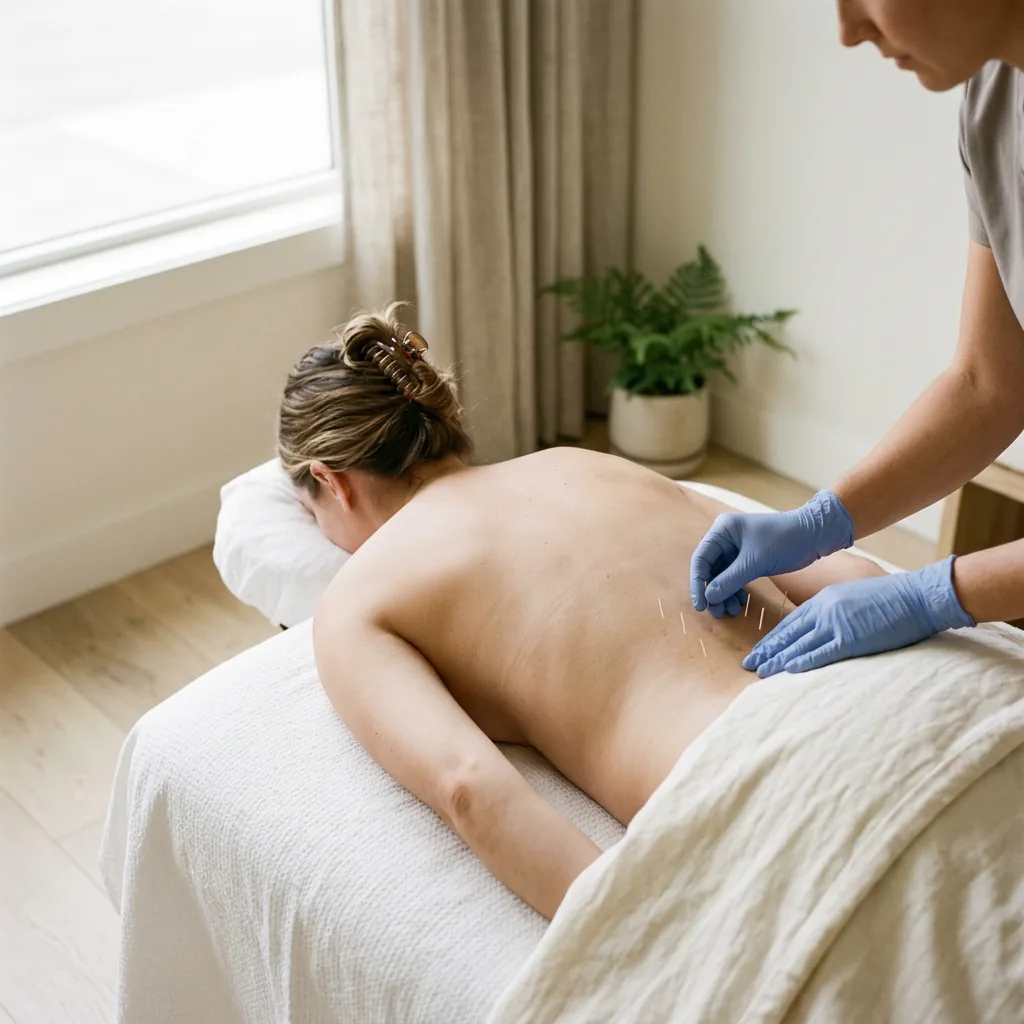
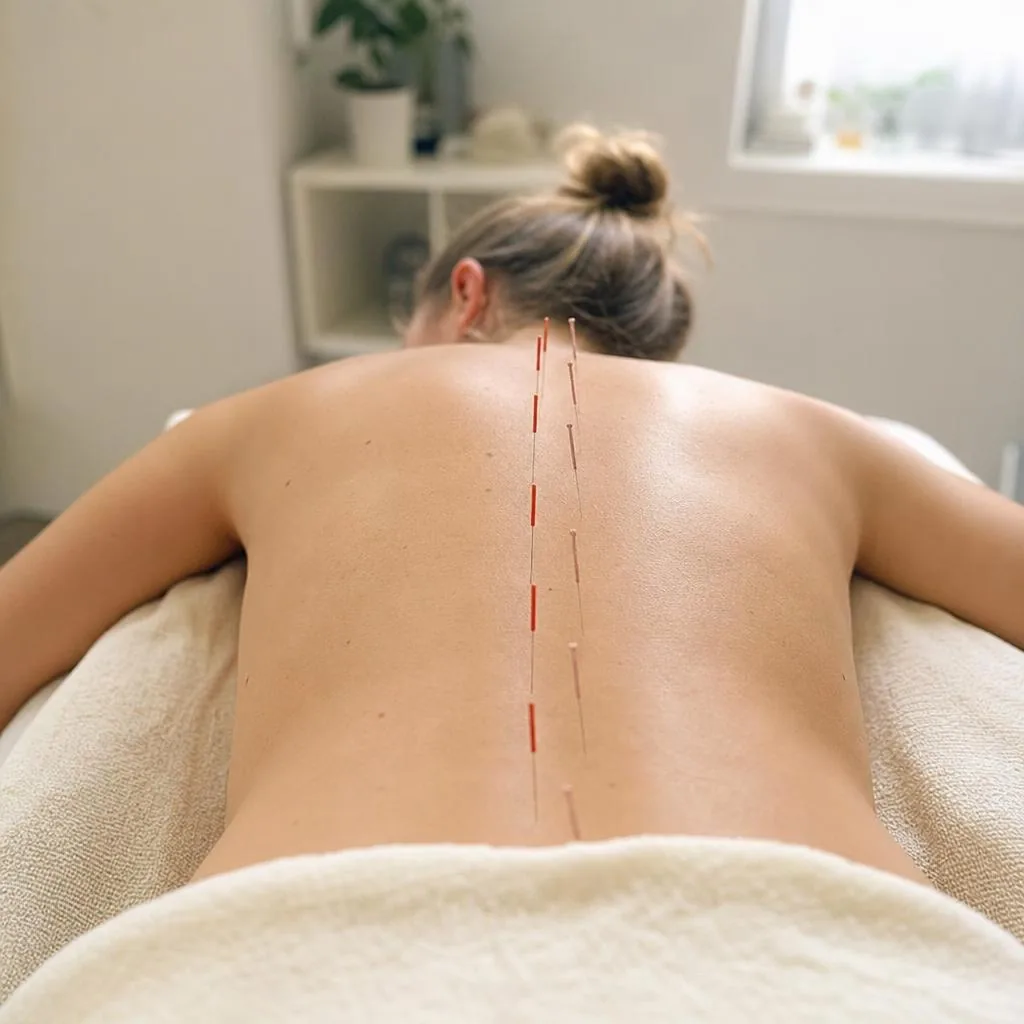
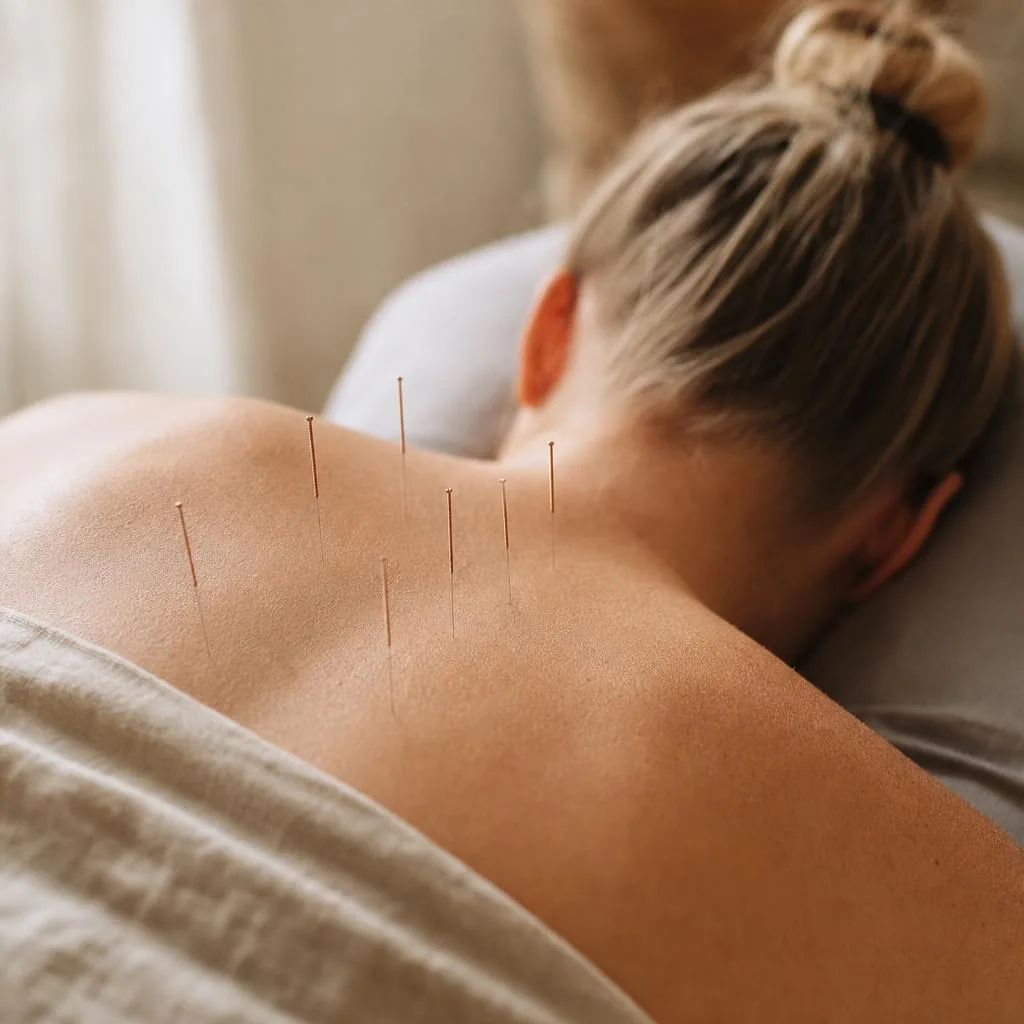
Inside the Treatment Room
Conditions We Treat
Lower back pain (lumbago)
The most common reason patients book a back pain acupuncture session — dull ache or sharp catch in the lumbar region, often worse after sitting or first thing in the morning.
Upper back & trapezius tension
Trigger points in upper trapezius and rhomboids that build up across a desk week. Often paired with headaches and a stiff neck that won't turn.
Sciatica & lumbar radiculopathy
Sharp, shooting pain that starts in the low back and runs down the buttock and leg. A primary focus for our pain-team acupuncturists.
Herniated disc pain
Lumbar disc bulges or herniations causing localized or radiating pain — acupuncture is often a useful conservative step alongside whatever your spine doctor is doing.
Postural strain from desk work
Forward head, rounded shoulders, weak gluteals, chronically tight hip flexors — the typical Midtown office-worker pattern.
Muscle spasms & lumbar strain
Acute strains from lifting, twisting, or sleeping wrong — the back that 'went out' on Tuesday morning. These often respond fast.
Sacroiliac (SI) joint dysfunction
One-sided low back pain that's worse with single-leg stance or rolling over in bed. Common postpartum and in runners.
Chronic myofascial pain
Trigger points that have been there for months or years and refer pain in predictable patterns — these are where acupuncture and cupping often combine well.
Benefits
- · Releases trigger points in upper trapezius, quadratus lumborum, and piriformis — the three muscles most often behind office-worker back pain
- · Down-regulates local inflammation around irritated facet joints and disc-level structures
- · Stimulates endorphin and enkephalin release for natural, drug-free pain relief
- · Restores blood flow along the bladder meridian — the channel that runs the full length of the back
- · Calms the autonomic nervous system, which reduces the muscle-guarding that turns acute strain into chronic pain
- · Works alongside any pain medication, muscle relaxant, or physical therapy regimen — no drug interaction
- · Addresses the TCM pattern (qi-blood stasis, kidney-yang depletion, cold-damp) so back pain is less likely to keep returning
- · Reduces reliance on NSAIDs and opioids — a goal we're glad to work toward together
What to Expect
- 1
Pain mapping & TCM intake (20 min)
We start by asking what hurts and when. Is it worse after sitting, after standing, first thing in the morning, by Friday evening? Where exactly — point to it. Does it shoot anywhere? Have you had imaging? We check your range of motion in flexion, extension, and rotation, palpate the paraspinals, glutes, and QL, and look at how you walk back to the room. Tongue and pulse follow. Then we explain the working diagnosis — both the muscular layer and the TCM pattern — in plain English (or Mandarin) before any needles go in.
- 2
Treatment session (40–45 min)
Thin sterile single-use needles go in along the bladder meridian on the lower back, with distal points on the hand and foot to balance the treatment. For most chronic back pain patients we add gentle electroacupuncture between two needles in the lumbar paraspinals — this is the technique that gives the fastest reduction in deep ache. Cupping or Tui Na on the upper trapezius and QL is often added in the same hour. You rest with the needles in for about 25 minutes; most people fall asleep on the table, which is part of how the autonomic nervous system resets.
- 3
Aftercare & next 24 hours
You get up slowly, drink some water, and most people walk out feeling looser than they came in. For the next 24 hours: keep moving (don't go straight to bed), no ice on the area we treated, a warm shower is fine, skip the hardest workout of your week. Mild soreness for a day after deep needling or cupping is normal — like the day after a moderate workout. We send you out with one or two stretches specific to where your back is tight, and we'll see you again in 3–7 days for the first follow-up.
- 4
Follow-up cadence
Acute back pain (weeks, not months) often responds in 3–5 visits. Chronic back pain of years usually takes 8–12 visits before the new baseline is reliable, often with a maintenance visit every 3–4 weeks afterward. We review every 4 visits — if nothing meaningful has changed by visit 6, we say so honestly and reconsider the approach, or refer you on.
Back Pain Acupuncture at a Glance
| What you want to know | Answer |
|---|---|
| First visit length | About 65 minutes — 20 minutes of pain mapping and TCM intake, then a 40–45 minute treatment. |
| Needle retention | You rest with the needles in for roughly 25 minutes. Most people doze off; that is part of the response. |
| What the guidelines say | The American College of Physicians includes acupuncture as an initial option for chronic low-back pain (moderate-quality evidence) and for acute low-back pain (low-quality evidence). |
| How long the benefit lasts | A pooled analysis of 20 studies (6,376 participants) found the pain benefit persisted for a year after treatment ended. |
| Languages | English and 中文, at 408 West 57th Street between Columbus Circle and 9th Avenue. |
Why patients choose Delight for back pain
Back pain — lower, upper, neck-into-shoulder, the whole range — is the single most common reason patients walk through our door on West 57th Street. Both practitioners treat it every week. Dr. Yu Qi, L.Ac. (MSTOM, 7+ years) has built her practice around acute and chronic pain — back pain, sciatica, frozen shoulder, migraine — and is comfortable with the diagnostic distinctions that matter: facet versus disc, SI joint versus piriformis, deep myofascial versus surface tension. Dr. Xaoling Shang, L.Ac. (DCAM, MSPT, MSTOM, NCCAOM-certified, 15+ years) brings the broader TCM internal-medicine view, which matters when back pain is tangled up with stress, poor sleep, or postpartum hormone shifts rather than being purely mechanical.
In the same hour we can combine acupuncture, electroacupuncture, cupping, and Tui Na — that combination is unusual outside a dedicated TCM clinic and is often what makes the difference for stubborn chronic back pain. The room is small, warm, and quiet. We adjust needle depth, current intensity, and cupping pressure based on your feedback during the session — this is not in-and-out treatment. Both practitioners are NY-licensed and bilingual (English / 中文), and the location near Columbus Circle, Lincoln Square, and Hell's Kitchen means you can walk over from a Midtown office or a UWS apartment without losing your lunch hour.
We coordinate freely with primary care, physical therapy, orthopedics, and pain management. If your back pain looks like it needs imaging, a spine consult, or an injection workup, we will say so — and refer. Acupuncture is one of the more conservative steps to try before escalating to procedures or long-term opioids, but it is not the right tool for every back, and we'd rather tell you that upfront than book you for a course unlikely to help.
Frequently Asked Questions
Will the needles hurt?
Most patients are surprised by how little they feel. Acupuncture needles are about as thin as a strand of hair — totally different from the hollow needles used for blood draws or injections. You'll typically feel a brief pinch on insertion, sometimes a heavy or warm sensation around the point once the needle is in (we call that 'de qi' — it usually means the point is doing what we want), and then nothing for the rest of the session. If a particular needle is uncomfortable, tell us and we'll adjust it.
How many sessions of back pain acupuncture will I need?
Honest answer: it depends on how long the pain has been there. Acute back pain (a strain that happened in the last few weeks) often resolves in 3–5 visits. Chronic back pain of months to years usually takes 8–12 visits before the new baseline is clear, with a maintenance visit every 3–4 weeks afterward to keep it from creeping back. We review every 4 visits, and if there's no meaningful change by visit 6, we'll tell you so and reconsider the plan rather than keep booking you.
Does insurance cover acupuncture for back pain?
Some plans do, particularly for chronic low back pain — Medicare covers up to 12 sessions per year for chronic low back pain specifically, and many private insurance plans (Aetna, Cigna, UnitedHealthcare, BCBS) include acupuncture benefits. Coverage varies a lot by individual plan. The fastest way to find out is to call the number on the back of your insurance card and ask: 'Do I have acupuncture benefits, what's my copay, and do I need a referral?' We're happy to provide a superbill you can submit for reimbursement even if we're out-of-network.
Can I do back pain acupuncture while pregnant?
Yes. Pregnancy-related back pain is one of the conditions acupuncture handles well — we just avoid a specific set of points contraindicated in pregnancy (we know which ones; you don't need to memorize them) and position you side-lying or with bolsters rather than face-down once your belly makes prone uncomfortable. Tell us your trimester and any pregnancy complications at booking. Dr. Shang in particular has extensive experience with prenatal and postpartum acupuncture.
Is it safe with my back pain medication or muscle relaxant?
Yes. Acupuncture has no drug interaction with NSAIDs (ibuprofen, naproxen, meloxicam), muscle relaxants (cyclobenzaprine, tizanidine), gabapentinoids (gabapentin, pregabalin), opioids, or steroid courses. We will never ask you to stop a prescribed medication on your own. As your back pain settles, your prescribing doctor may suggest tapering — if so, we'll adjust our schedule to support that pace.
How quickly will I feel results from the first session?
Many patients walk out of the first back pain acupuncture session feeling looser and lighter — sometimes 20–30% better immediately. That initial relief often fades after a day or two as the body returns to its baseline; the cumulative, lasting change builds over the next 3–5 visits. A smaller group feels nothing after the first session and meaningful change after the second or third. A very small group feels no change after 4–6 visits, in which case we honestly reconsider whether acupuncture is the right tool.
What should I wear?
Loose, comfortable clothes you can easily roll up at the sleeves and ankles. For back pain specifically, we'll usually have you change into a treatment gown or expose just the lower back area — we use draping so only the working area is uncovered at any time. Skip tight jeans and elaborate undergarments that hook in the back. If you're coming directly from the office, we have a small changing area.
Can I exercise the same day as my acupuncture session?
Light movement is fine — a walk, easy yoga, your normal commute. We'd skip your hardest workout of the week on the day of a deeper session, especially if we used electroacupuncture or cupping on the back. Give the treated muscles 24 hours to integrate. If you have a race or important workout within 48 hours of your session, tell us at booking so we can keep the session conservative.
Research & references
Every clinical statement on this page traces back to one of these sources. They are U.S. federal health agencies and academic medical centers — not our own marketing.
NCCIH — Low-Back Pain and Complementary Health Approaches
A 2017 evaluation of 49 studies with more than 7,900 participants found evidence of a modest benefit for acute low-back pain and a moderate benefit for chronic low-back pain.
NCCIH — American College of Physicians low-back pain guideline
The American College of Physicians clinical practice guideline includes acupuncture as an option for initial treatment of chronic low-back pain (moderate-quality evidence) and for acute or subacute low-back pain (low-quality evidence).
NCCIH — Acupuncture vs. sham and no-treatment controls
A 2018 review of 12 studies (8,003 participants) found acupuncture more effective than no treatment for back or neck pain, and 10 studies (1,963 participants) found it more effective than sham acupuncture. NCCIH describes the pain-relieving effect as comparable to that of NSAIDs.
Citations are summarized — please read the originals. This page is general health education, not medical advice for your specific case. Results vary, and acupuncture and Chinese medicine work best alongside, not instead of, care from your physician.
What Our Patients Say
5.0 · 23 Google reviews5.0 average across 23 verified Google reviews. Shown exactly as written.
★★★★★Amazing! After first acupuncture visit — major improvement. Added cupping and massage — results were immediate and I felt great relief from past pains. Thank you Dr. Shang.
★★★★★Highly recommended! Dr. Shang is a very skilled acupuncturist and I enjoy the treatment every time when I come here.
★★★★★Best acupuncture clinic in town! Dr. Shang is very professional and nice to everyone. I'm coming here regularly and feeling much better now!
Don't Let Back Pain Control Your Life
Schedule your back pain evaluation today and take the first step toward a pain-free life.
Related Services
Sciatica Acupuncture — Natural Sciatic Pain Relief
Don't let sciatica control your life. Our specialized acupuncture treatments target the root cause of sciatic nerve pain, providing lasting relief without drugs or surgery.
Pain Relief Acupuncture — Holistic Pain Management
Living with chronic pain? Our Manhattan acupuncture clinic specializes in natural pain management. Experience lasting relief without drugs or surgery through proven Traditional Chinese Medicine techniques.
Tui Na Massage — Chinese Medical Massage Therapy
Discover Tui Na (推拿)—the therapeutic massage system of Traditional Chinese Medicine. More than relaxation, Tui Na is a powerful healing modality that treats musculoskeletal conditions, relieves pain, and restores balance to your body.